


Edition #013: CNTs in composites, coatings, and the business of useful conductivity



Think back to where you were on 10 January 2023. I know where I was. Reading an LG Chem press release. It was the highlight of my day. LG Chem was making a front wing (Americans call it a fender) out of a plastic, good old LUCON TX5007 (used in Mitsubishi’s RVR, Delica D:5 and Outlander). No danger. But this plastic would also have carbon nanotubes in it! Big news. LG Chem says the plastic fenders save about 4 kg compared to a steel fender.
This got me thinking at the time (it didn’t). Why put carbon nanotubes in a front fender? 4 kg a car part sounds nice, but I'm not sure that makes it worth it. Well, a little research sent me down a rabbit hole about paint.
A car body gets painted as a single lump of metal. I am sure you’ve seen the videos of a robot arm spray-painting cars on the factory line. Interestingly, the paint is attracted onto it electrostatically, where paint particles are given an electrical charge while the car body is given the opposite charge, causing the paint to be drawn to the metal car body. Plastic doesn’t conduct, so put enough nanotubes in the plastic and the panel can be earthed like the metal around it, so the charged paint has something to be drawn to.
Which made me laugh at the time (it didn’t) because this application isn’t new at all. Hyperion Catalysis was selling nanotube fibrils into paintable bumpers and fuel lines in the 1990s. So the best 2023 example I could find is basically the job CNTs were already doing 30 years ago.
Meanwhile, for those same 30 years, everyone said nanotubes were "stronger than steel". I said a version of it too. In the primer (Edition #001) I put aerospace and composites up there with batteries, and said NASA, Airbus, Boeing and Lockheed were trialling CNT-reinforced materials.
So today, we look at CNTs in composites and coatings, and ask: are they being used because they are stronger than steel, or are they still only making cars easier to paint? Spoiler: mostly the second. But that second job is less humble than it sounds: it means giving an ordinary material a valuable function it did not have before. By the end I will say why.
5 Things You'll Learn
- We don’t know how many CNTs go into plastics and paint. One of the biggest multi-walled makers gets about 97% of its revenue from batteries. And the published market sizes vary so wildly they are hard to follow. I also checked whether EU chemicals rules are what's holding Europe back. I don't think they are, or not mainly.
- In plastics, CNTs won on electricity. CNTs are still used for fuel lines and paintable panels, mostly. Same as in the 1990s, and still the clearest production story. The lesson: the value is often not maximum conductivity, but enough conductivity from a very small amount of additive. Nothing like copper’s is required.
- Coatings and tyres are earlier-stage. A CNT primer for car plastics has been "in validation" since 2021. I couldn't find a commercial CNT tyre either. The public evidence still says qualification rather than volume.
- Nothing is flying on an airliner. A few space one-offs have flown. So I owe you a correction on the primer.
- "Stronger than steel" was true for one tube. Bulk materials never got close. But this year's lab fibres beat the best carbon fibre on paper. I'd watch that.
I. Where are all the CNTs?
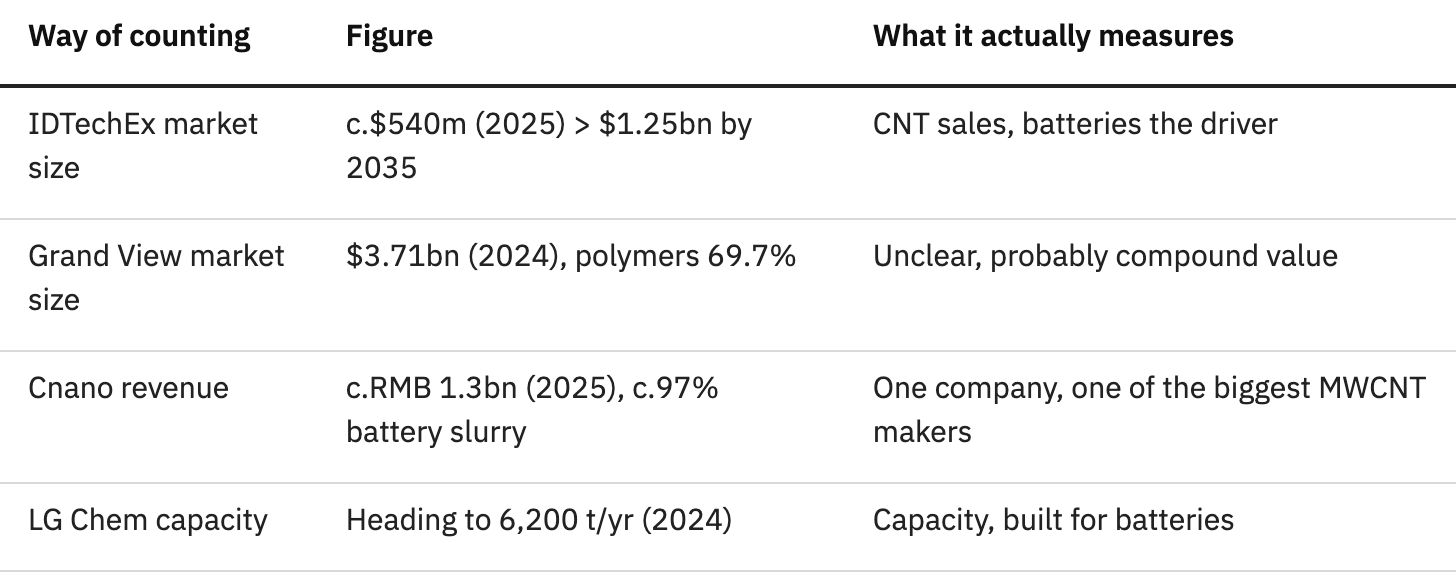
In the battery edition (#008) I said batteries take about 60-65% of the world's CNTs. The next obvious question is: how much goes into plastics, coatings and rubber? Well, I couldn't find it. And my job is to do research. If you can get your Fable 5.1 Ultracode to find it, you have a larger token budget than me. As far as we can tell, nobody publishes the split.
Oddly, the company numbers I could find were from Cnano, the Chinese vendor. It has about half of China's multi-walled market. It has roughly RMB 1.3bn of revenue in 2025. About RMB 1.26bn of that was battery slurry, 97%. So we learn, its plastics business is too small to report on its own. Cnano also says it shipped about 75,000 tonnes. That's slurry though, not powder.
The market sizes are all over the place. Depending on who you ask, the CNT market is either heading past $1.25bn by 2035, mostly on batteries (IDTechEx), or was already $3.71bn in 2024 with "polymers" taking 69.7% (Grand View Research). They can't both be measuring the same thing? My guess is Grand View counts the value of the plastic with the tubes in it. Their method isn't public though, so I can't be sure. Either way, be suspicious of any "polymers are 70% of the CNT market" line.
One more number surprised me. OCSiAl, the big single-walled producer, is registered under EU chemicals rules (REACH) to sell up to 100 tonnes a year in Europe. That's the band it chose. It got to 10 tonnes in 2016, then spent four years on toxicology studies to reach 100 in 2020. The next band up is 1,000 tonnes. That needs longer studies again, and for nanomaterials there are no agreed test methods, so every study gets haggled over with the regulator. As far as I can find, no CNT maker anywhere is registered in Europe above 100 tonnes. The US has no tonnage bands. It isn't a free-for-all though. Every nanotube there counts as a new chemical, and the maker can only sell it for the uses it notified.
So is this why Europe has been slow on nanotubes? I went in thinking it might be. I don't think it is, or not mainly. China, Korea and Japan hold over 90% of multi-walled capacity. Europe's producers stalled long before any of these rules bit. Bayer shut Baytubes in 2013 after the price fell from about $700/kg to $50 and nobody was buying. Nanocyl has had the same 460 tonnes of capacity since 2010. Arkema's 400-tonne plant has been a pilot since 2011. OCSiAl's new plant in Serbia makes 60 tonnes a year, well inside its own band. The volume went to batteries after 2018, and the cell makers and their suppliers are in Korea and China. Europe doesn't have them. I'd put regulation third, behind batteries and carbon black.
Now a guess. A lot of capacity has been built for batteries; LG Chem alone is heading to 6,200 tonnes a year. If battery demand wobbles, the spare tubes go looking for new buyers. Plastics and coatings are the obvious ones, because there the nanotubes are an additive, not the whole product.
II. In Cars
Okay, so now we have established, firmly, that we don’t really know how many CNTs are used in plastics, composites and coatings. Let’s ask a more useful question: what function are customers actually paying the CNTs to provide?
The LG Chem story from the introduction tells most of the story. It is not really about paint; it is about giving a plastic an electrical function it does not naturally have. Fuel flowing through a plastic line builds up static. And clearly, you really don't want a spark near petrol, so the line has to guide the charge away. Hyperion's fibrils went into exactly these parts from the 1990s. Arkema still sells multi-walled tubes for fuel lines today, at 2-3% by weight. It’s old and boring, but it’s an honest-to-goodness application area with customers.
The competition is carbon black, the soot that makes tyres black. It conducts, and importantly it’s cheap. The CNT pitch, though, is that you need far less. OCSiAl says its single-walled tubes work from 0.01%. It says multi-walled tubes need 10-20x more, and carbon black about 100x more.
Fwiw, those are vendor numbers, and OCSiAl isn't even consistent on them. I've seen 0.01%, 0.03% and 0.1% in different places, so I wouldn't build a spreadsheet on them. But the direction makes sense. Less filler keeps more of the plastic's own strength. That is the more interesting commercial metric: not “how conductive is a nanotube?” but “how little nanotube do I need to make this material more useful?” And carbon black only comes in black (while nanotubes can come in colour; more on that in a later issue). If you want a light grey primer or a coloured part, carbon black can't help you.
Notice what that job actually asks for. Not a wire carrying current across a continent. A bare plastic panel is a near-perfect insulator, and the paint line needs it to become a merely bad one, leaky enough for the charge to drain away. Copper isn’t in that conversation. In plastics and paint the market has paid for “conductive enough”, not “conductive as copper”, and a nanotube network has been conductive enough for thirty years.
It also changes the sum. If the vendor loadings above hold (and I have said I would not bank on them), a kilogram of single-walled tubes treats between one and ten tonnes of plastic. Cheap tubes at high loading can lose to dearer tubes at low loading.
Past fuel lines and paintable panels, it’s lean out there. In 2021, OCSiAl and Kanat said their CNT primer for car plastics was "undergoing validation" with carmakers. I couldn't find an approval since. Maybe you can? CNT tyres also turn up in OCSiAl's marketing, Goodyear prototypes and patents, but we don’t yet have a tyre you can buy. We’ve also heard discussion about CNTs in brake pads to increase thermal management when the pads get hot. Also, shielding for EV battery packs is mentioned a lot, to stop electrical noise getting in or out, this one is at patents and prototype stage. All of these are interesting, but hard to verify.
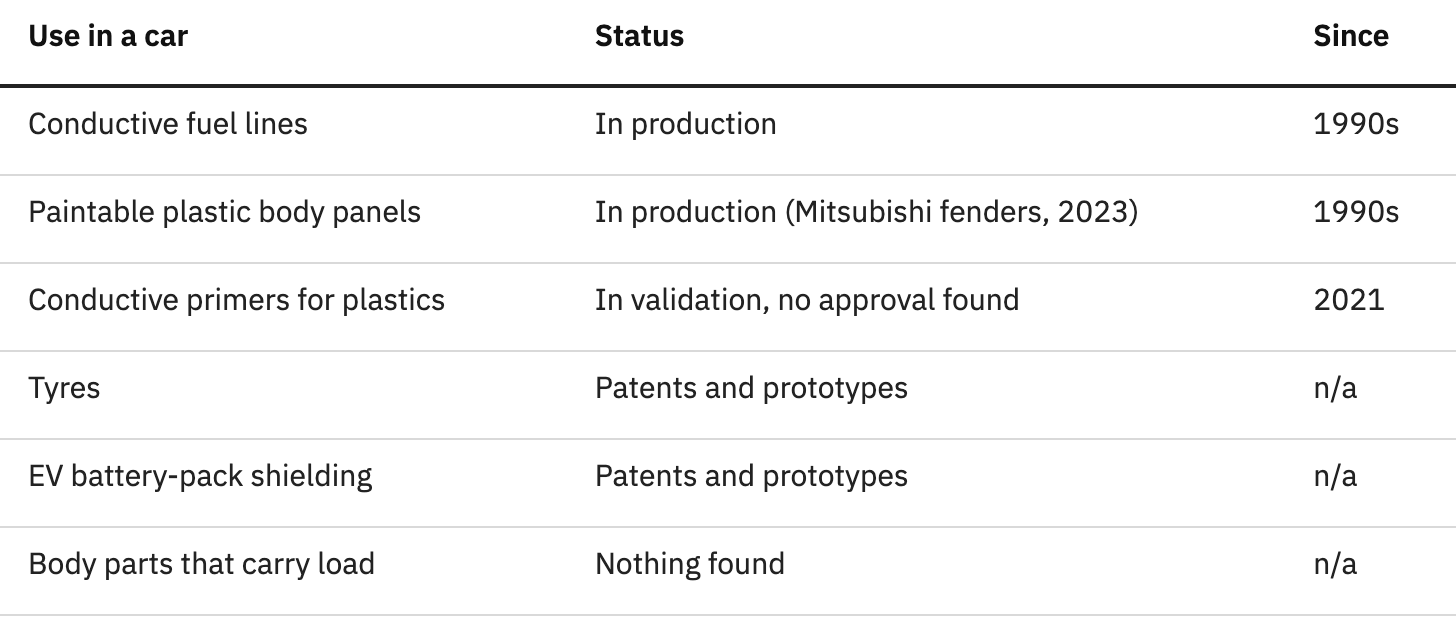
A correction while I'm here. In the datacentre edition (#005) I called "structural composites" production-ready. I was sloppy. I meant plastic parts with tubes in them, like cable trays. There the tubes help with static, and maybe a bit of stiffness. What I have not found is public information or production evidence that CNTs are being bought chiefly because they improve the load-bearing structural integrity of the active commercial part, maybe you the reader can enlighten me?
III. In Fighter Jets
In the primer I said NASA, Airbus, Boeing and Lockheed were trialling CNT-reinforced materials "from fuselages to solar array arms". Trialling, yes. Flying is currently a shorter list. Everything I found that has flown went to space. NASA's Juno probe launched in 2011 with a Nanocomp CNT sheet on it, to bleed off static. In May 2017 NASA flew a CNT-yarn pressure vessel on a sounding rocket. They called it the first structural flight test of the material, but there isn’t any post-flight data. The sheet and the yarn both came from Nanocomp, a small New Hampshire company. Huntsman, the big American chemicals group (the Araldite epoxy people), bought it in 2018 and renamed the material Miralon. It now sells Miralon into satellites.
On airliners, we aren’t in production yet. Despite clear interest and budget, I found no Boeing, Airbus, FAA or EASA programme with CNTs in a flying part. Lots of great functionality like lightning-strike protection, toughened prepregs and de-icing heaters, but they are all still lab work and demos. Qualification takes a long time, so I think it’s just a matter of time before we see something public. But that speaks to a point I’ve made before, qualification for aviation and defence takes a very long time. That does not prove CNTs are “nearly there”, but it does matter strategically: a material that has already accumulated years of testing, data and process knowledge is hard to displace. It also means new materials and soon-to-be discovered AI-generated compounds still have to go through the lengthy process before production, certification and then use.
It’s worth noting that the F-35 comes up a lot. In 2011 Lockheed got a wingtip fairing approved, made of a "nanostructure thermoplastic". Some reports say it had nanotubes in it, others don't mention them. Either way, a fairing just smooths the airflow and carries no real load. So it’s a cool use case and name, but we can’t generalize a larger market from this.
The final place to look for volumes is Huntsman. It's run a 30 tonne-a-year pilot plant in San Antonio since early 2025. From what I can see in its filings, the much bigger reactor is targeting thermoplastics and battery additives. Aerospace isn't in the plan. In March 2025 it partnered up with Advanced Material Development on "electrically enhanced" composites. That looks less like a retreat from the structural dream than a clue about sequencing: electrical functionality in thermoplastics and composites can become a market before CNTs ever have to carry the whole load.
IV. But “Stronger than steel”
I think we are learning that the market is buying CNTs for conductivity first. That is not the same thing as saying strength does not matter. It means conductivity has been the easier property to monetise in bulk materials. Which brings us back to “stronger than steel”, a hell of a pitch. The phrase actually came from a 2000 paper in Science. Min-Feng Yu and colleagues pulled 19 multi-walled nanotubes apart inside an electron microscope. The outer shell broke somewhere between 11 and 63 GPa. In 2008 another group got single tubes past 100 GPa on average, by avoiding the damage chemical processing does. A good structural steel breaks at around 1-2 GPa. So for one shell of one tube, tens of times stronger than steel was fair.
But of course, nobody builds anything out of one tube. A fibre or a sheet is millions of short tubes holding onto each other. And it’s the grip between neighbouring tubes that matters, and that is weak, more like friction than a bond. Which is to say, if you pull hard, they slide past each other rather than break. And they're also short, badly lined up, loosely packed and full of leftover catalyst. In 2018 a Tsinghua group showed that even a near-perfect bundle fails one tube at a time. Each tube that goes puts more load on the next.
The 2005-2012 wave of "nanotube" sports gear mostly ducked all this. There were a whole host of equipment like Easton bats, BMC frames, Amroy's resins, and, this will wake you up so I’ll put in bold: “Zyvex's 54-foot Piranha unmanned boat”. I’ll say again “Piranha unmanned boat”. An autonomous boat designed to resist Piranhas? I don’t know the reasons, I just do the research. But the point is, in all of them the tubes were a small additive in the resin, and it was the carbon fibre that did the structural work.
NASA has spent a lot of money finding this out. In a 2024 NASA presentation, they say: resin with a bit of CNT in it behaves like "very short chopped fiber composites". Their own lessons-learned slide says the structural uses never materialised. NASA also funded an institute, US-COMP, from 2017 to mid-2023 to make composites from CNT yarn. It got to about the same strength as a standard aerospace carbon-fibre laminate (IM7), and about twice the stiffness. The bond between yarn and resin was still unsolved at the end.
But this year the numbers have got more interesting. In July a team at East China University of Science and Technology reported a CNT fibre at 12.5 GPa in Nature Communications. Toray's best commercial carbon fibre, T1100G, is rated at 7.0 GPa. Rice University’s wet-spun fibres, the route DexMat is commercialising, are at about 4.2 GPa.
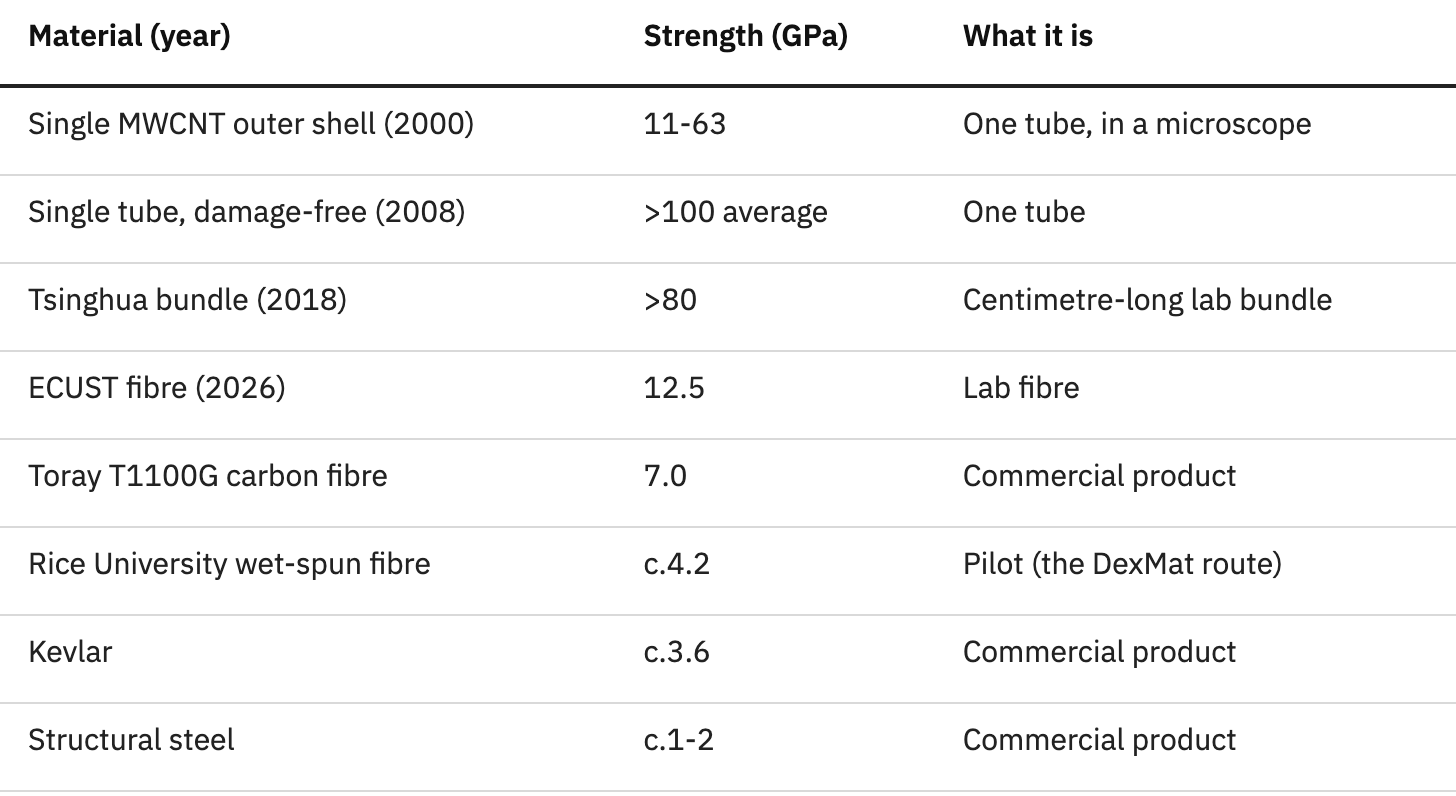
(Huntsman quotes its Miralon yarn at 1.77 N/tex, which is strength per weight, so it doesn't fit the column. Roughly, N/tex is GPa divided by density.)
Nobody has shown that a lab fibre keeps its strength once it's a tow, then a laminate, then a part. Not at carbon fibre's cost and volume, anyway. Costs are falling, but mostly for the powder. In Edition #002 I had industrial multi-walled tubes at about $40/kg, with projections of another 10x drop over five to ten years. In #003 I said fibres and sheets run on different economics, and that still holds. The best evidence on fibre cost is still the one from the wires edition (#004). TE Connectivity showed CNT wire costs could fall 85% in four years, but for reasons to do with cannibalizing the main business, they walked away before anyone ran the volume.
Cyrus Mody's line in Edition #011 was that a research bubble only bursts when there's somewhere better to go. Structural CNT composites looked a bit like that to me. The money and most of the people drifted off to batteries and conductors. The strength work carried on in a handful of labs, until this year's numbers turned up.
So what?
So where does that leave us? Nobody knows how many nanotubes go into plastics and paint. What we do know is that the big volume went to batteries, and the battery supply chain is concentrated in Korea and China. That, plus cheap carbon black, helps explain why Europe has been slow; EU chemicals rules come third. But battery-led scale may also do something useful for the rest of the market: make CNT supply cheaper, more consistent and easier to formulate into ordinary industrial materials.
In plastics, nanotubes won on electricity. A car panel you can paint with the rest of the car or a fuel line that won't blow up. That was true in the 1990s and it's still the best production story in 2026. The important bit is what the story teaches: CNTs do not need copper-like bulk conductivity to create commercial value. They need to cross the functional threshold of the host material at a loading and price the customer can live with. Primers, tyres and shielding are still waiting. And despite efforts, nothing has yet flown on an airliner (that we know of, yet).
"Stronger than steel" was true for one tube. But bulk materials never got close, and the 2000s wave of nanotube sports gear was mostly carbon fibre with a bit of CNT in the resin. NASA spent years on the structural problem and its own lessons point toward electrical performance as the nearer-term payoff. That sounds less heroic than replacing steel, but commercially it may be more useful: a small amount of CNT can change what a much larger amount of plastic, resin or coating is capable of doing.
But the lede is that this year the lab numbers changed this picture. On paper a CNT fibre beat the best carbon fibre. Costs are falling for the powder, though, and nobody has made that fibre into a part at carbon fibre's price, at least publicly. So for now this is still an electrical business, but the commercial map is broader than “beat copper or fail”. CNTs can earn their keep as conductive additives in thermoplastics and coatings, as specialist conductors where weight and durability matter, and, if the new fibre results survive scale-up, as structural reinforcement later. The common bottleneck is not one heroic property. It is making the right CNT, consistently, at useful volume and cost. That is where the next phase of the industry gets interesting.
For TrimTabs, whose site carries this newsletter, paints and thermoplastics are two routes being pursued for its single-walled nanotubes. They fit the evidence above: a buyer whose problem is well understood, an incumbent filler in carbon black that is cheap but needs a lot of it and only comes in black, and a conductivity bar that a nanotube network can clear. There is also a pleasing loop in thermoplastics for a company that makes its nanotubes from waste plastic: the carbon could go back into plastic.
Stronger than steel may be what gets nanotubes into the headlines. “Conductive enough” is what has been getting them into products.
If you formulate paints, coatings or thermoplastics and would like to test our nanotubes, write to hello@trimtabs.co.
Thanks, Lawrence x


