


CNT Dispatch #012 — CNTs, the End of Copper, and a Metre a Minute


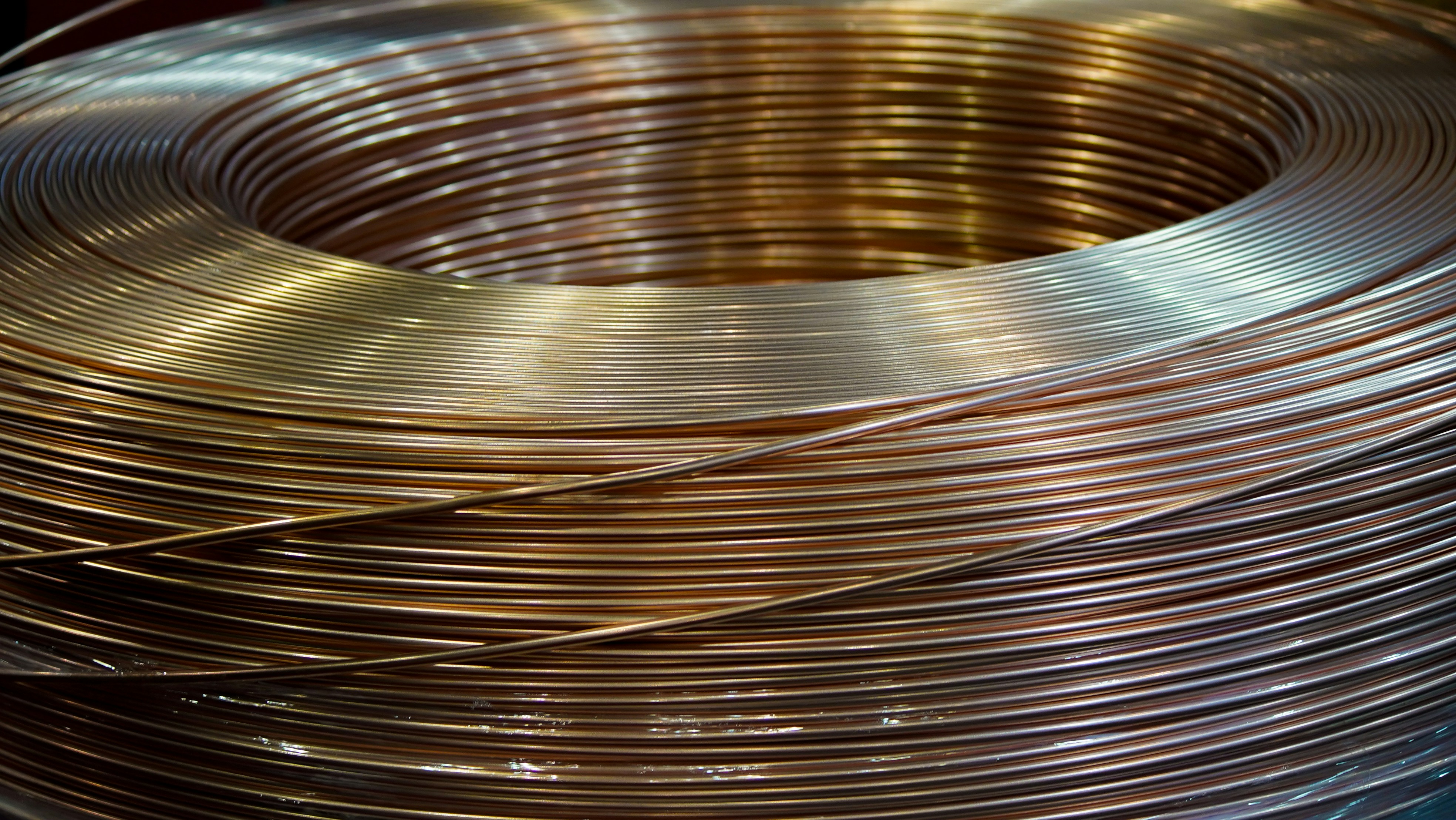
CNTs, the End of Copper, and a Metre a Minute
A conversation with Alvin Orbaek White, CEO of TrimTabs
Edition #012: Why the next phase of carbon nanotube conductors is less about proving the physics, and more about manufacturing them reliably.
The end of copper has been 6 months away for 30 years. Carbon nanotubes are lighter, stronger, more conductive in theory, never quite there in practice. I stopped getting excited about new CNT papers a while ago, the gap doesn’t close, copper gets on with its day.
What changed? The world is running out of cable. The Financial Times flagged it back in 2023: the high-voltage cable market had gone from $3 billion of annual orders in the late 2010s to over $20 billion, with three companies (Prysmian, NKT, Nexans) controlling more than 75% of it. It’s tighter now. NKT’s transmission backlog hit €13.5 billion this year, Prysmian’s is around €16 billion, and the big suppliers are booked into 2028. A 700km UK-to-Germany interconnector slipped 4 years on cable supply alone. The Nexans CEO called this “the third electrical infrastructure revolution in Europe”, then locked in a 5-year Chilean copper supply deal because the era of abundance was over. Copper demand is forecast to climb more than 110% by 2050 on AI data centres and electrification, and as of January 2026 S&P Global has the supply shortfall still widening.
Into that, 2 new papers. In April, Juan Vilatela’s group at IMDEA Madrid published in Science, getting more conductivity per kilogram out of a CNT fibre than copper can manage, by slotting a chlorine-aluminium dopant between aligned nanotubes. A few months earlier, Tongzhao Sun’s team at Peking University did the trick from the other direction, packing a different dopant inside the tubes themselves. Both groups crossed a threshold that had remained stubbornly out of reach for decades: achieving conductivity per unit weight beyond copper. Sun's group reported a specific electrical conductivity of 14,166 S·m²/kg, more than double copper's, while maintaining a current carrying capacity of 1,241 A/mm². Vilatela's group reached a similar conclusion through a different chemical route. The significance is not that CNTs suddenly became superconductors. It is that engineers can now point to multiple independent demonstrations showing that, on a weight-adjusted basis, carbon nanotube conductors are beginning to compete with one of the most successful engineering materials ever discovered.
Sun’s also beats it on the current it can take before melting, by 28%. Both look stable enough to leave a lab. This newsletter has circled copper for 4 issues (#001, #004, #005, #006) watching it get slowly cornered. These are the first papers that make me think it’s actually happening.
So I rang Alvin Orbaek White, CEO of TrimTabs, from our primer interview back in #001 to find out if now really is the time for CNTs to replace copper.
What I Learned
1. The wire was never the right unit of analysis. Most CNT pitches I see are “same wire, less copper, lighter”. Fine. The thing Alvin made me see is that the unit of analysis is wrong. Once you swap out copper, the motor changes shape, so does the transformer, so does the rack, so does the satellite harness. The whole electromagnetic furniture of the modern economy, basically. The real story is not simply a better wire; it is a manufacturing platform that gives customers new design freedom in electrical and thermal infrastructure
2. A metre a minute is enough to start. 1 metre per minute. I assumed this was tiny until I noticed in the FT piece that 1 metre per minute is also, somehow, the rate the global HVDC cable industry has been running at for decades. TrimTabs is now producing CNTs for fibre at a rate that makes early, high-value applications worth taking seriously. The markets that pay for the high-end stuff (satellites, aerospace, fast chargers, data-centre interconnect) are where every gram matters and 1 metre a minute is already enough.
3. The 2026 breakthrough is junction engineering. For 20 years the field’s strategy for beating copper was making the nanotubes longer, so there’d be fewer junctions between tubes and less resistance along the wire. The 2026 papers go a different way. Use the junctions instead. Put controlled defects in the tube walls so the junctions act as conducting pathways. The semiconductor industry has been doing this since around 1970 with carrier engineering. The CNT field, 30 years later, has borrowed the trick.
* * *
I. Why It Took 30 Years
Lawrence: Help me with the obvious one. Every 5 years a paper says copper’s finished and every 5 years it isn’t. I’ve read both 2026 papers and I want to believe them, but I’ve wanted to believe a lot of CNT papers and been wrong. So: is this round actually different, or am I about to be wrong again?
Alvin: Copper will not disappear. But the assumption that every serious conductor must be copper (or a metal, for that matter) is beginning to weaken.
For 30 years, the challenge was never simply understanding what carbon nanotubes could do. The challenge was manufacturing them consistently, economically, and at industrial scale.
The physics has been compelling for decades. What has changed is the industry’s ability to produce high-quality nanotubes, process them into useful forms, and begin integrating them into real products.
The interesting shift is that the conversation is becoming less about scientific possibility and more about industrial execution. For most of the field’s history, the question was whether carbon nanotubes could become practical conductors. Increasingly, the question is who can manufacture them reliably, economically, and at scale. That is where TrimTabs sits: not as a single-product wire company, but as a CNT industrialisation platform spanning materials, conductors, and eventually modular production systems.
The more interesting answer today, is about junctions. Conductivity in a CNT wire or cable has historically been held back by what happens between tubes. In practical fibres and cables, electrons have to move across many junctions between adjacent nanotubes, and performance can be lost at each junction. For the last 10 or 20 years the field’s answer was to make the tubes longer, to avoid the junctions. Ultra-long CNTs reduce the number of junctions, they never eliminate it.
What both 2026 papers do, from opposite directions, is stop trying to eliminate junctions and embrace them. They put controlled defects into the tube walls so that the junctions act as part of the conducting paths rather than as big resistance hops. Sun’s group does it endohedrally (inside the nanotubes), with molybdenum chloride coupling to nitrogen that is formed via plasma seeding wall defects. Vilatela’s group does it interstitially (between neighbouring nanotubes), threading chlorine-aluminium anions between aligned tubes. Sun works inside, Vilatela works between, and both end up engineering a similar kind of conducting pathway.
For anyone who’s worked in semiconductors, this is familiar territory. Controlled defects as carrier transport pathways have been a chip-industry tool since the 1970s. The CNT community has effectively borrowed the playbook. I had a long conversation last week with an electrical engineer who’d worked on CNTs for 20 years and given up on the field on cost. He’d seen these results and changed his mind, which is not something many 20-year veterans of any field do quickly.
And then there’s the smaller, more personal answer. I know these researchers. I’ve read 15 years of work from both groups. I know who they trained with, what they’ve claimed before, and how those earlier claims held up. There’s a historian at Maastricht called Cyrus Mody who writes about the CNT hype-cycle history, 3 cycles and 3 crashes, each with its own cast of believers. The groups still publishing in 2026 are the ones who treated the previous cycles as data. Vilatela and Sun are in that category. I take their numbers seriously because of who they are, more than because the numbers are themselves miraculous.
Instead of trying only to eliminate junctions, the field is engineering around them.
Lawrence: Two groups, Madrid and Beijing, get to roughly the same place from opposite directions. One slots a dopant between the tubes, one packs it inside. Convergence from independent groups usually means a field has matured, but I’m always nervous I’m reading too much into coincidence. How are you reading it?
Alvin: Two groups landing close to each other from completely different chemistry within 6 months tells you something. It’s how a field looks when the underlying physics has been understood well enough, then the chemistry is proven, then comes large scale engineering and multiple paths open up. Vilatela’s fibre wins on absolute conductivity, Sun’s on stability and current capacity, which means different customers will pull on different versions of the technology. The worst position a material-science field can be in, is when one paper, one group, one process, dominates the thinking. But this one has 2 of each.
Vilatela’s chemistry wins on absolute conductivity per kilogram; Sun’s wins on current capacity and thermal stability.
What excites me most isn't just that either paper beats copper on a particular metric. It's that two independent groups arrived at broadly similar conclusions through very different approaches. That's usually what a field looks like when it is moving from scientific discovery toward engineering maturity.
For most of the last 30 years, the central question was whether CNT conductors could ever achieve the performance people hoped for. Increasingly, the question is becoming who can manufacture them reliably, economically, and at a useful scale.
Lawrence: Let’s talk production. You’re producing multi and single walled nanotubes. Your prototyping wires capability is at say 1 metre per minute, which I learned the day before this call is roughly the same rate the global HVDC cable industry runs at. The first time I read that I thought it was a coincidence. Where does it actually put you on the curve?
Alvin: At the front end, it puts us in the high-value, lower-volume segment: satellite harnesses, aerospace bundles, specialist EV cables, and other applications where weight, performance, and qualification matter more than commodity pricing.
We are not yet talking about kilometres of overhead transmission cable. That comes later for the field as a whole.
Our focus is improving throughput, consistency, and performance together. The challenge is no longer simply proving CNT conductors work in principle. The challenge is producing them repeatably, at industrial quality, and at costs customers can justify. Ultimately, the competitive advantage in this field may belong as much to manufacturing systems as to materials themselves. TrimTabs gives customers access to advanced carbon-based infrastructure without requiring them to become CNT experts themselves. That is ultimately an engineering and manufacturing problem, which is where TrimTabs has concentrated its efforts.
We do not think the future of advanced materials is one enormous factory serving the entire world. We think it is modular production systems that can be replicated wherever customers need them. Ultimately, customers are not buying nanotubes. They are buying access to electrical and thermal performance that would otherwise be difficult or impossible to achieve.
Lawrence: Length is the bit nobody talks about enough. There’s an old joke, CNT conductivity drops a decade for every order of magnitude you add, and last time I checked properly it was about right. Is it still?
Alvin: It’s less true every year, and the reason ties straight back to the junction story. The joke was true because conductivity was bounded by the worst junction along the fibre. It’s like the story that the chain is only as strong as the weakest link, the weakest link recently was the junction. Longer wires and cable just led to more junctions and more chances for a bad one.
That old industry joke is becoming less true. The newer work suggests junctions may not have to remain purely a penalty. With the right chemistry and structure, they can become part of the conducting pathway rather than simply a source of loss. That’s why both 2026 papers hold their numbers at fibre length scales.
* * *
II. Where the End of Copper Starts
Lawrence: So nobody’s ripping copper out of substations next year, that’s obviously not the play today. But there’s got to be a first real market, somewhere this wins on economics today rather than in a pitch deck. Where is it?
Alvin: Space is one of the clearest early markets, because every kilogram has a direct economic consequence. A satellite can carry tens or hundreds of kilograms of wiring depending on the mission, and launch costs make weight reduction unusually valuable.
But the important point is not that customers are buying nanotubes. They are buying qualified components that solve a problem. The value is created when advanced materials become dependable industrial products. For TrimTabs, that means serving customers at three levels: CNT materials, conductor products, and the production systems needed to make those products repeatably.
Aerospace, defence, high-power charging, and data-centre interconnects are all areas where weight, heat, current density, lead times, and qualification matter. Large-scale grid transmission is a later opportunity, not the first market.
Our task now is straightforward, though not easy: turn laboratory performance into qualified industrial products. The companies that solve that manufacturing challenge will determine how quickly CNT conductors move from research papers into real systems.
Every kilogram of cable you save is a kilogram of payload you can carry.
Lawrence: Fast charging. EV cables keep getting thicker and heavier as the current goes up, and at some point the cable’s own weight and heat start determining what the standard can handle. I keep hearing that CNT is the way out of this, but I haven’t seen the maths laid out. Run me through it.
Alvin: Fast charging is a useful example because the cable is not just an electrical component; it is also a thermal, ergonomic, and manufacturing constraint. As power levels rise, copper cables become heavier, stiffer, and more dependent on thermal management. CNT conductors are interesting because, if the laboratory performance can be reproduced consistently at industrial scale, they could enable lighter, more flexible, higher-power cable architectures
The latest CNT fibre results are interesting not because they are marginally better than copper, but because they begin to attack the constraint that defines modern fast-charging systems. Sun's group reported a current carrying capacity of 1,241 A/mm², compared with roughly 970 A/mm² for copper. On its own that number is just a laboratory measurement. In practice it points toward a future in which charging cables can carry more current with less mass and potentially less thermal-management hardware. The cable stops being the limiting component in the system.
As power levels rise, copper cables become heavier, stiffer, and more dependent on thermal management. The attraction of CNT conductors is that, if the laboratory performance can be reproduced consistently at industrial scale, they could allow lighter, more flexible, higher-power cable architectures than are practical with copper today.
The opportunity is not simply to replace an existing cable. It is to rethink the design constraints that existing cable technologies impose.
Lawrence: Right, widen it out for me. Generators, transformers, motors, basically the whole electromagnetic guts of the economy is wound with copper. I find it genuinely hard to picture what changes if you swap the metal out. Is it just lighter, or does something bigger happen?
Alvin: The bigger opportunity is that conductors shape the systems around them. If you change the conductor, you may eventually change the geometry of transformers, motors, racks, harnesses, and thermal systems.
For electrical engineers, the important question is not whether a CNT wire is marginally lighter than a copper wire. It is whether the conductor changes the design envelope of the machine around it. A material that combines multi-gigapascal strength with conductivity approaching 30 MS/m and conductivity-per-weight beyond copper invites different optimisation choices than a traditional metal conductor. The consequence may not be a better wire. It may be a different motor, transformer, satellite harness, or power-electronics architecture.
Let's look at transformers first. Right now, structural copper losses within transformers alone account for a staggering 2% of all global electricity generation. Replacing those legacy copper windings with our highly conductive, low-density nanotube fibre fundamentally slashes that baseline resistance. At a macro scale, that represents an entire continent's worth of generating capacity you suddenly no longer need to construct.
But electric motors are where the engineering geometry truly rewrites itself. A standard electric vehicle motor is currently 30% to 40% copper by mass. When you substitute that heavy metal with our advanced conductor platform, the motor dramatically shrinks and sheds weight. Because the powertrain is suddenly lighter, the entire structural chassis of the vehicle can shed mass, which allows you to downsize the battery pack while maintaining identical range—which instantly loops back to requiring an even smaller, lighter motor.
But that only matters if the material can be manufactured, qualified, and integrated reliably. The prize is not simply a lighter wire. It is giving engineers new design freedom once the conductor becomes dependable enough to specify.
Lawrence: And where does TrimTabs actually sit in all of this? I never quite know where to draw the line with you, do you sell the fibre, the finished cable, the motor? What’s the thing the customer’s actually buying?
Alvin: At the fundamental level, we’re building the manufacturing capability that allows an entire industry to exist.
I describe TrimTabs as a CNT industrialisation platform. We are building a platform technology that operates across three layers: advanced CNT materials, conductor products, and modular production systems. Different customers may engage with one layer or all three.
At the highest level, customers are buying access to a new class of carbon-based electrical and thermal infrastructure. Depending on the application, that may involve CNT materials, conductor products, or production capability itself.
For decades, carbon nanotubes have been scientifically fascinating but industrially difficult. The challenge was never proving the physics. The history of advanced materials is full of inventions that worked in a laboratory and failed in a factory. The challenge was turning that physics into something manufacturers could reliably buy, qualify, and deploy.
We think of ourselves less as a cable company and more as an industrialisation company.
Our role is to turn exceptional laboratory materials into products engineers can specify, manufacturers can integrate, and customers can depend on.
That means building not only conductors, but the manufacturing systems required to produce them repeatably and at scale. Historically, advanced materials have often succeeded in the laboratory long before they succeeded in the factory. We see manufacturing capability itself as part of the product. Over time, that points toward modular manufacturing units rather than a single centralised mega-plant: production capacity that can be replicated, adapted, and located closer to the customers and supply chains that need it
The long-term opportunity is not simply producing CNT conductors. It is helping create the industrial infrastructure that allows CNT conductors to become a reliable part of global supply chains.
That requires control over critical stages of the value chain, from nanotube production through conductor manufacturing. The exact form factor may vary by application, but the underlying mission remains the same: closing the gap between scientific possibility and industrial reality. In practical terms, that means helping customers access advanced carbon-based electrical and thermal infrastructure without asking them to become CNT manufacturers themselves.
Lawrence: End of copper? It’s a huge claim and I want to pin you to something I could actually check rather than another exciting paper. What’s the one KPI, the actual result, that would tell you the field’s crossed the line?
Alvin: The real KPI is a production-grade CNT conductor that holds its performance consistently over useful lengths, can be manufactured repeatably, and can pass the qualification standards required by demanding customers.
The field has spent over 30 years demonstrating what carbon nanotubes can do in the laboratory. The next decade will be about high-performance CNTs that can be manufactured reliably, economically, and at scale.
Madrid and Beijing have shown what is scientifically possible. The companies that matter next will be the ones that make those capabilities available as real products.
That is the transition now underway: from scientific risk to engineering risk. That is where TrimTabs intends to compete.
The most important question for the next decade is no longer whether carbon nanotubes can outperform copper. It is whether they can be manufactured reliably, economically, and at industrial scale. That is where TrimTabs is focused: building the industrial platform that transforms CNT science into manufacturable materials, conductors, and deployable production systems.
* * *
Thanks for reading. Alvin sent me a press release the day after the call listing carbon nanotubes among materials someone is now claiming to be room-temperature superconductors. He put “superconductivity” in quote marks, which I’m choosing to read as the right amount of scepticism. Every CNT cycle has its hype claims and this one’s already started. The papers actually worth reading in 2026 aim at copper-equivalent. Which is a much smaller claim than superconductivity, much more useful, and much less catchy in a press release. Anyway. If you’ve got 4 tonnes of copper harness in a satellite about to launch, reach out to Alvin before the next launch window closes.


