


Hello one and all.
In Edition #005, we explored the role of CNTs of a modern AI datacenter. We walked through the facility, pointing out where nanotubes are replacing copper in high-speed cabling, aluminum in EMI shielding, and reinforcing the structural composites of the rack itself. That was the macro scale. Today, we wanted to zoom in a bit further. We will focus on the most critical constraint facing the AI supply chain.
For fifty years, the fundamental constraint of computing was lithography, actually "printing" the chips. It was all about the optical precision of ASML scanners and the chemical purity of silicon wafers. We spent half a century asking: how small can we print a transistor?
That question has been answered. Very small indeed. But maybe not much smaller? As we move into the era of sub 3nm-class nodes and massive AI clusters, the constraint has shifted. The bottleneck is no longer how fast we can switch a transistor, but how effectively we can extract heat generated by that switch before it destroys the device.
We're standing at a thermodynamic event horizon. Hyperscale AI infrastructure, typified by the NVIDIA GB200 NVL72, has created a thermal management crisis that copper heatsinks and spinning fans can no longer solve. We are witnessing the end of the air-cooled era and the difficult, plumbing-heavy birth of the liquid-cooled data center.
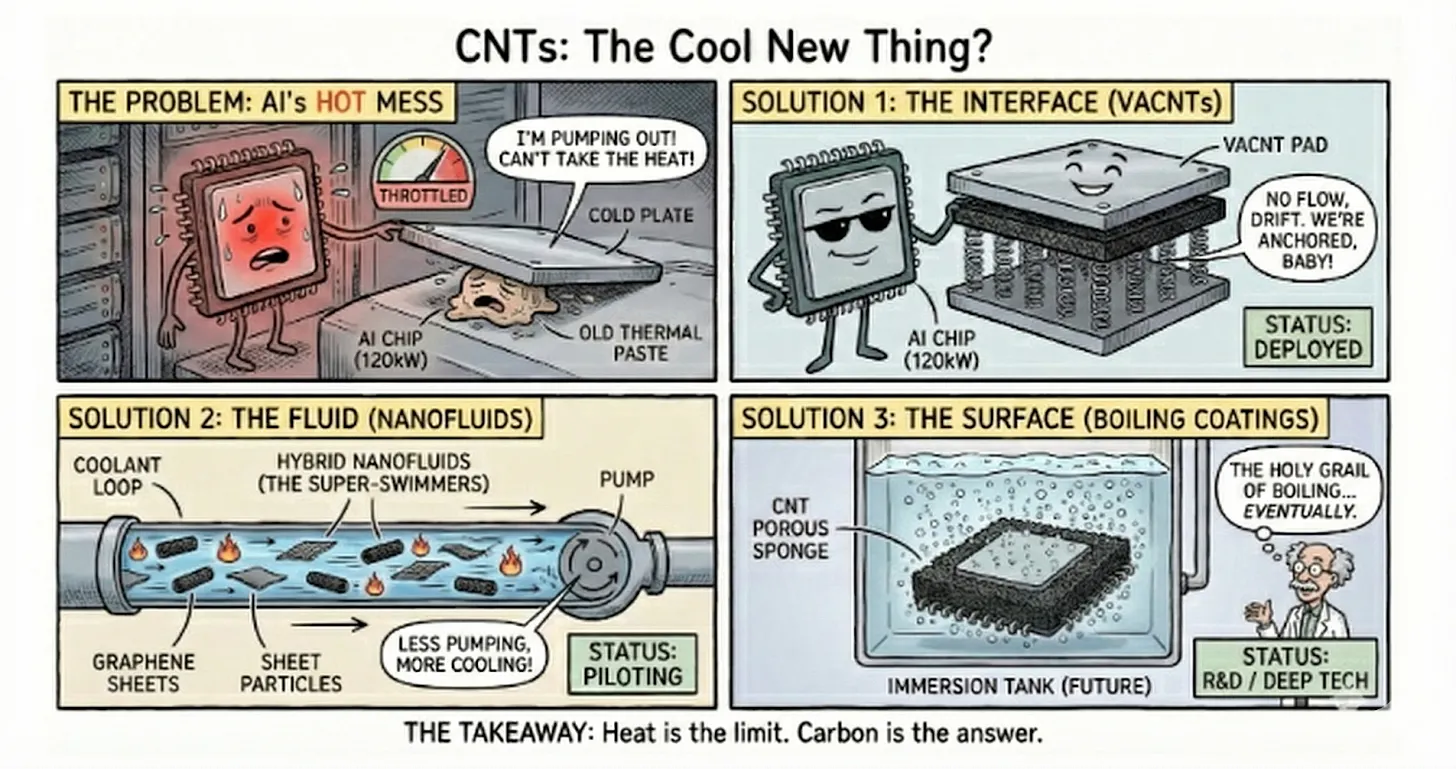
In this transition, the efficiency and reliability battle is being fought on three fronts: the Interface (TIMs) where the chip meets the lid, the Fluid (Nanofluids) what flows through the pipes, and the Surface (Boiling Coatings) how we boil liquids in immersion tanks.
Dealing with 120 kWs
To understand why exotic materials like vertically aligned nanotubes are suddenly being qualified by chemical giants like Dow, you have to look at the load. The standard enterprise server rack consumed between 5 kW and 15 kW of power for the last decade. At these levels, air cooling does the job. But now we have AI.
Legacy Enterprise Rack: ~15 kW. NVIDIA H100 Rack: ~40 kW. NVIDIA GB200 NVL72: ~120 kW.
The jump from 40 kW to 120 kW is exponential in terms of engineering difficulty. At 120 kW, air cooling is impossible. The volume of air required to cool a GB200 rack would turn the server room into a wind tunnel. The acoustic vibration from the fans would destroy the read/write heads of hard drives and rattle optical interconnects loose.
The industry has no choice but to switch to Direct-to-Chip (DTC) liquid cooling. In these systems, a cold plate sits directly on top of the GPU and CPU dies, circulating water or glycol to whisk heat away. But this shifts the main thermal resistance to the microscopic gap between the silicon die and that cold plate.
Opportunity I: The Interface (TIMs)
Status: Deployed / Critical
The TIM is the layer of "paste" between the silicon die and the cooling lid (TIM1) or the lid and the cold plate (TIM2). This layer exists to displace air. Even highly polished silicon and copper surfaces are, on a microscopic scale, rough valleys and peaks. When you press them together, they only touch at the peaks. The TIM's job is to fill those valleys.
For years, the industry relied on silicone greases and pastes. But high-power GPUs like the Blackwell B200 basically ruin these pastes. The failure mode is driven by the Coefficient of Thermal Expansion (CTE) mismatch. Silicon expands at ~2.6 ppm/°C. Copper heat spreader expands at ~17 ppm/°C. When a training job starts, the chip heats up. The copper lid expands significantly more than the silicon die beneath it. This differential expansion creates a shear force that drags the viscous thermal paste outward toward the edges of the chip. Over thousands of cycles, this "pumping" action migrates the material out of the interface, leaving the hottest part of the chip dry.
Today, hyperscalers get about an 8 to 12% degradation in performance on identical hardware over a 6 to 12 month period. For a cluster that costs $1 billion to build out, a 10% efficiency loss is effectively $100 million in capital destruction.
Vertically Aligned Carbon Nanotubes (VACNTs)
The breakthrough, commercialized by companies like Carbice, is the Vertically Aligned CNT (VACNT) array. Imagine a forest of nanotubes grown perpendicular to a substrate.
Ballistic Transport: Heat travels down the length of the tube, the path of least resistance, directly from the hot die to the cool lid. The "Velcro" Effect: Under compression, these vertical tubes buckle and bend. They conform to the microscopic roughness of the surface just like a liquid paste would. No Pump-Out: Because the tubes are chemically anchored to the foil substrate, they cannot flow away. They act like millions of microscopic springs. When the copper expands and contracts, the tubes flex, but they stay put.
VACNT pads offer a consistent 13 to 20 W/mK through-plane conductivity that is physically incapable of drying out.
In October 2024, Dow and Carbice announced a strategic partnership. For Dow, the giant of the silicone world, to partner with a CNT startup is a tacit admission that polymer chemistries have reached their thermodynamic limit. The future of the interface is structural, not chemical.
Opportunity II: The Fluid (Nanofluids)
Status: Pilot / Emerging
In a liquid-cooled data center, the working fluid is almost always water or a water-glycol mix. Water is cheap, predictable, and has a decent thermal capacity. But thermally, it is an insulator compared to metal. To remove 120 kW of heat using water, you have to pump it fast. The cooling infrastructure — the chillers, pumps, and towers — can consume 20 to 40% of a data center's total energy.
The concept is simple: dope the water with thermally conductive nanoparticles. By turning the fluid itself into a composite material, you can radically increase its ability to carry heat. A leading player is NanoGEIOS, currently piloting a hybrid nanofluid for liquid CO2 and closed-loop water systems. Their formulation utilizes a mix of Graphene Oxide (GO) and Carbon Nanotubes (CNTs) in a 1:1 ratio. Graphene (2D sheets) provides massive surface area, while CNTs (1D tubes) act as bridges, preventing the graphene sheets from restacking and creating a percolation network for heat transfer. NanoGEIOS reports a 77% increase in thermal conductivity compared to pure liquid CO2.
The key challenge is viscosity. Adding solid particles to a fluid makes it thicker. If you increase the thermal conductivity by 50% but also increase the viscosity by 50%, you might actually lose performance because the fluid becomes harder to pump. CNTs, with their incredibly high aspect ratio, are theoretically the best candidate for breaking this ratio, but dispersion technology remains the limiting factor.
Opportunity III: The Surface (Boiling Coatings)
Status: R&D / Deep Tech
The final opportunity looks past the current generation of cold plates to Two-Phase Immersion Cooling. In two-phase cooling, the entire server rack is submerged in a bath of dielectric fluid. The liquid boils directly on the surface of the hot chips. The phase change from liquid to vapor absorbs massive amounts of energy.
The efficiency of this process depends on Nucleation. Bubbles form at microscopic imperfections on the surface of the chip. If a chip gets too hot too fast, bubbles merge into a single continuous film of vapor that coats the chip. Vapor is an insulator. This phenomenon, known as "Film Boiling" or the Leidenfrost effect, causes the chip temperature to spike instantly, leading to destruction. This limit is called the Critical Heat Flux (CHF).
Researchers, most notably at Purdue University, have demonstrated that coating the heat spreader with a porous layer of Carbon Nanotubes can radically alter the boiling physics. The porous CNT mesh acts like a wick, sucking liquid coolant in towards the hot surface via capillary action. The coating reduces the "superheat" required to start the process by up to 72% and delays the onset of film boiling, allowing chips to be pushed to higher power densities safely.
Reading the Board
The TIMs opportunity is Now. The operational pain of pump-out is so acute, and the financial cost of performance drift so high, that the industry is already abandoning pastes. VACNT pads are drop-in ready, require no redesign of the cold plate, and solve the reliability crisis instantly. Expect this to be a standard manufacturing process for NVL72-class racks within 18 months.
Nanofluids are Next. As rack densities push past 200 kW, the parasitic energy cost of pumping water will become a board-level issue. Startups like NanoGEIOS and FlexeGRAPH have proven the physics; now they must prove the longevity.
Boiling Coatings is the Future. It is an elegant solution, but it requires a shift to immersion cooling, which involves a massive infrastructure overhaul: tanks, cranes, fluid handling. It will happen, but it will lag behind the other two.
The takeaway: Heat is the limit. And where heat is the limit, Carbon Nanotubes is the answer.


